
Before he was 18 years old, Elberton’s Eugene “Gene” Wallace had never been aboard a ship.
By the month after his 19th birthday, he’d traveled over 26,000 miles, by ship and train, halfway across the world as a member of the United States Navy’s units of “Seabees” in World War II.
Growing up on Wilson Street in the “Mill Village,” Gene was the second-born of Hut and Eunice Flynn Wallace’s six children.
“There’s a lot of people that didn’t like the cotton mill down there, but that was one of the best places you could be raised,” Gene remembered fondly. “It was like being a big family.”
When he was 13, Eunice passed away, leaving behind Gene’s 15-year-old sister, Sara Lee, to raise the herd of boys – Gene, Ezra, Joe Brown, Lawrence and 11-month-old Troy.
In order to help make ends meet for their family, Gene started working on a milk truck for $7 a week. At 13, he would wake up at 5 a.m. seven days a week – rain, shine, cold and hot – and deliver milk across town. During the week, he’d deliver the milk and then make his way to school.
The week he turned 16, in April of 1943, Gene left school and went to work with his father in the cotton mill, making $0.40 an hour, or $16 a week.
“I didn’t go to school enough to know what was going on. My mother died and daddy didn’t have an education at all. He couldn’t write his name,” Gene said. “When I drew my check, I’d get maybe just a few nickels or dimes out of that $16.”
After working in the mill for over a year, Gene took a job in the granite business at Elberton City Quarry for $18 a week, and stayed there until he volunteered for the Navy.
One day walking around the Elberton square, Gene saw a Naval recruitment officer who he said had an office above present-day Ward’s Pharmacy. He followed him to the office, filled out the paperwork and was notified he’d been accepted.
“From then on, I just took orders,” Gene said. “I never asked where we were going or anything. I just took orders. I never did question them.”
It was then that Gene began his over 26,000-mile journey, across the country and to the Pacific, from 1945 to 1946. After being sworn in in Macon, Gene traveled to the Naval Station Great Lakes in Illinois, where he trained for around seven weeks until being picked to go to Camp Endicott in Rhode Island.
Around six or seven weeks later, Gene was then transported by train from Rhode Island to Camp Parks in California. Gene said he remembered the nearly week-long train trip made making just two stops along the journey – one in St. Louis, Missouri and another in Amarillo, Texas.
Gene stayed in California for around two weeks before finally shipping out, headed towards Japan.
Less than a week into the journey, the ship encountered a typhoon.
“The captain said he didn’t think it was going to be that bad, but it got bad,” Gene remembered. “Waves were 40 to 50 foot. The wind was over 100 miles an hour. That ship, I saw as much of it go out of sight as there was above water.”
At one point, Gene said a crew went around and sealed the doors of the ship because it was turning too much.
“They were afraid it was going to flip over,” Gene said. “They said if it didn’t turn over 45 degrees, we were alright. One night that thing turned 44 degrees. It stood straight up nearly on its side.”
When the ship docked in Yokohama Bay, Japan, Gene said General Douglas MacArthur “wouldn’t let” them off the boat.
“He told them he didn’t want no Seabees at all in Japan,” Gene said. “All he wanted in Japan was the army.”
The group of Seabees then made their way toward Guam, where they stayed for four or five weeks. One day, Gene said he was outside the Naval office when someone told him they were looking for 40 or 50 volunteers to go to Yap Island, located east of the Philippines and southwest of Guam.
“I didn’t even know it was on the map,” Gene laughed.
After staying on Yap for nearly two months, Gene was moved once again, this time further southwest to Palau Island. Upon arriving in Palau, the group of Seabees weren’t needed and were transported back to Guam, where Gene stayed for the remainder of his service.
During his time with the Seabees, Gene worked to build roads, haul gravel and other materials and worked in the chow hall.
“The Japanese were still there because they had an airstrip up there. I saw them Jap Zeros,” Gene said of the Japanese fighter aircraft used in the war he saw while on Yap Island. “I didn’t know exactly where the pilots where, but you could throw a rock and nearly hit where those pilots were, the ones that flew over us. Everything that went up the mountain with a load, they told us not to go around them or anything [and] stay out of there. They didn’t know whether they were booby-trapped. They didn’t want anybody hurt. We stayed out of there. I didn’t need any souvenirs noway. I was going to look after me.”
According to the U.S. Naval History and Heritage Command website, Seabess in the Pacific Theater “built 111 major airstrips, 441 piers, 2,558 ammunition magazines, 700 square blocks of warehouses, hospitals to serve 70,000 patients, tanks for the storage of 100 million gallons of gasoline and housing for 1.5 million men.”
One day working on Guam, Gene said he realized he’d been with the Navy longer than the “victory in six months” commitment he’d signed on for. With the war ending in the pacific in September of 1945, while Gene said he was in Rhode Island, he was put on a ship back to the United States.
Gene traveled back via the USS Wakefield, a ship he still recalled the measurements for. At 705 feet long, 86 feet wide and three decks high, the USS Wakefield was on its last voyage back to the states during Gene’s trip.
The ship traveled from Guam to the Panama Canal and up to New York where it was decommissioned, according to the U.S. Coast Guard’s website.
From New York, Gene took a train to Jacksonville, Florida and caught a ride with five other guys to Atlanta, where he then took a final bus ride home to Elberton. Gene was officially discharged in Jacksonville on May 25, one year to the date from when his journey began.
“I saw the Golden Gate Bridge on one end, come around, [and] saw the Statue of Liberty,” Gene said of his year-long trip.
Gene settled back in his hometown and went back to working in the granite industry at Harmony Blue. After working at Harmony Blue three different times, Liberty, Worley Brothers, Universal, modern Granite Company and Apex, Gene retired from Wallace Granite Sales at the age of 93 in 2020.
On July 25, 1947, Gene married Martha “Lucy” Truitt after just dating her one time.
“We got in the car together and I wasn’t even thinking about marriage. She wasn’t either she said,” Gene remembered of the day. After the other couple they were with talked about getting married, Gene said they all went to Washington and made it official.
As Lucy was only 16, she went back home and the couple decided to wait to tell her father until she finished school for the year. Gene couldn’t wait, and the next weekend, Lucy told her father.
“I’ve had things happen in my life, but that’s the best thing that ever happened in my life was her,” Gene said fondly of his wife, who passed away in November 2021. “We were together 74 years and four months. We never were separated no more than when one of us was in the hospital.”
Together the couple had three children – Roger Wallace and their late daughters Chris Rice and Elizabeth Wallace, four grandchildren – Mark Wallace, Melinda Oglesby, Amy Strong, Maeson Flowers and the late Heather Purcell and six great-grandchildren – Alex, Jordan and Emaliegh Oglesby, Mary Claire Wallace, Lawson Strong and Kambrie Rose.
Now, at 95, Gene said looking back on his service as a Seabee, he often wonders what would’ve happened if his time in the war had been different.
“I didn’t think about it much then, [but] if I’d went into into an invasion would I have made it? I see movies of some of the old world war movies, and there were so many thousands killed,” Gene pondered. “I just think about then, if I’d went in, how I would’ve come out. I’m glad I served.”
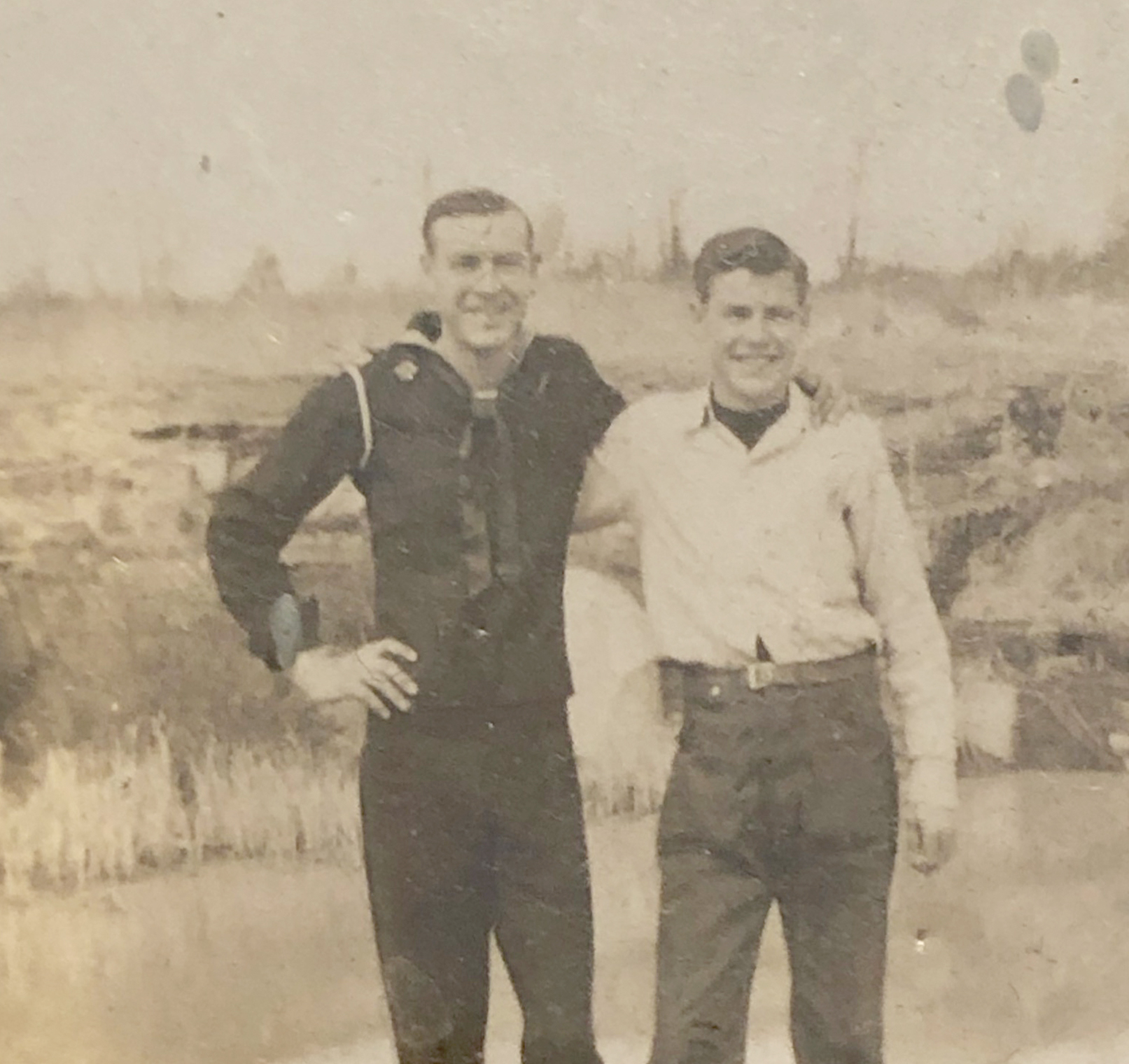
Eugene “Gene” Wallace (left) visits his brother, Ezra Wallace (right) on a short trip home during his time as a Navy Seabee in 1945.
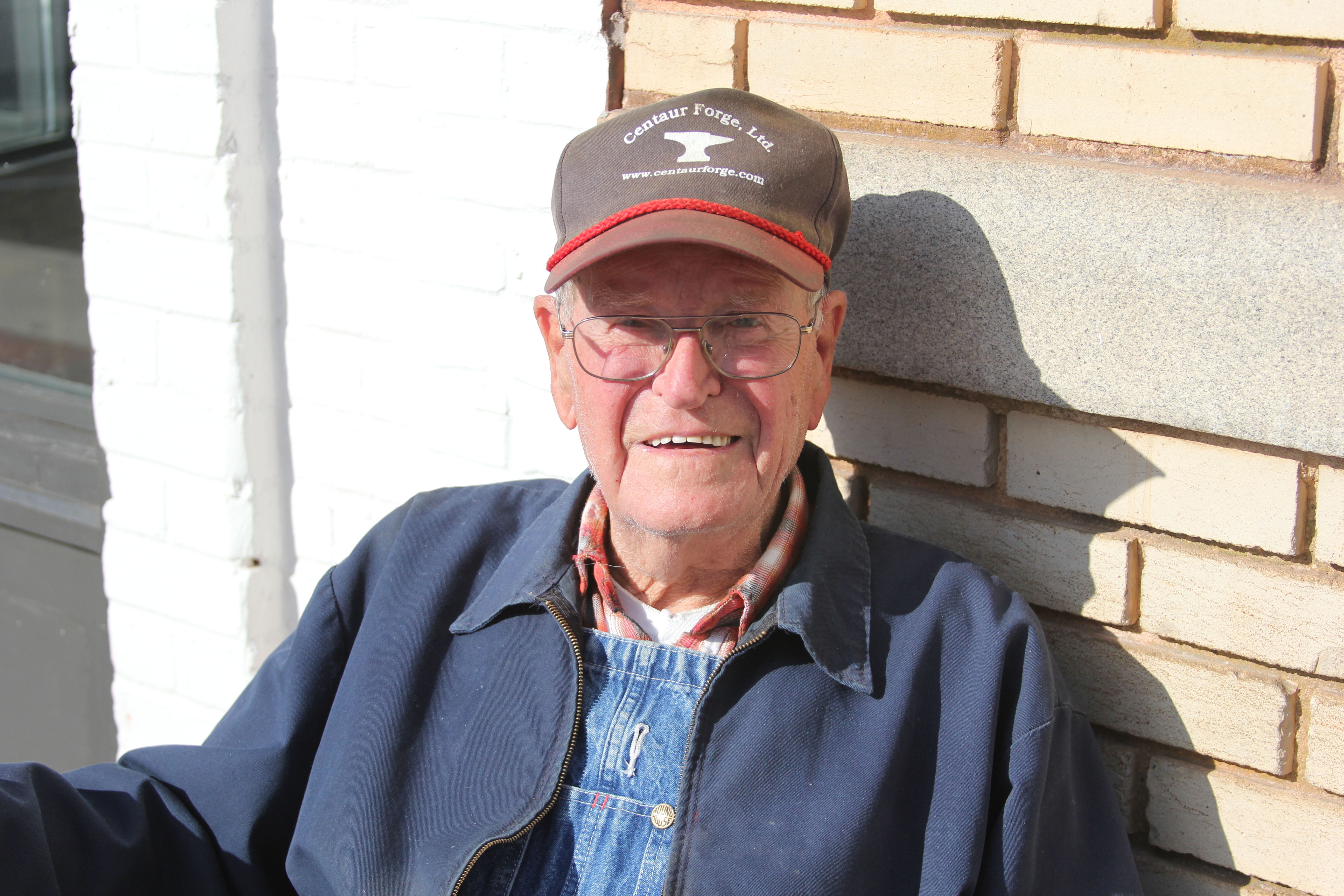
Gene, now at 95, recently remembered his over 26,000 mile, year-long time in World War II. (Photo by Scoggins)