
By Mark Wells
mwells@elberton.com
In the hot summer months of the early 1960s, in a field near St. Paul Christian Methodist Episcopal (CME) Church on Mobley Hill Road, the St. Paul Braves, an all-African American baseball team was formed. Over a span of three decades the team made a habit of beating any team that was willing to play them.
“We won a lot of games,” Murray “Mooney” Morrison, left fielder for the Braves, said. “One year we played 24 games and only lost four games.”
First baseman and eventual manager for the team, Abe Plummer, said there was a year where his Braves went undefeated and another year where they played 49 games and only lost one of them.
Before the St. Paul Braves were formed, Morrison said they began their relationship with baseball by playing what he called “ragball” in a field off of Bakers Ferry Road.
“We played with a sock,” Morrison said laughing. “You’d roll it up in a ball and sew it together and you could knock it a long way too. We didn’t have a glove, so you could use your hands with the sock.”
Morrison said he and some of his teammates started playing baseball when they were 12 to 15 years old and were taught by Morrison’s uncle, Albert Allen.
“He taught us how to do everything about baseball,” Morrison said. “He made you play.”
He said he and his friends relished the opportunity to play with the “older guys” until Morrison said the older guys left town.
It was then, Morrison said, that Allen gathered everyone together and they decided to form a team that called themselves the St. Paul Braves. He said the name came from a combination of St. Paul CME, a church in their neighborhood, and the major league Atlanta Braves.
Some of the older members of the team provided them with equipment like balls and gloves and they had their own uniforms with “St. Paul Braves” written across the chest.
The team was managed by William “Skipper” Thompson and founding members included Enoch Huff, George C. Cleveland, Willie Allen, Will Davis, Herman Harper, John Thompson, Eddie Morrison, Brewer Teasley, Eddie Sanders, David Cleveland, Leroy Cleveland, Dimps Allen Jr. and Morrison.
“All of us just got together,” Sanders, second baseman for the Braves, explained. “All of us who played, when it started, all of us lived in the same neighborhood. I don’t know how we started doing that on Sunday but we did it every Sunday. Then we moved to Mobley Hill.”
They played on the field off of Mobley Hill Road for about 10 years and then, Morrison said, they moved to the field by the Burke Street gym for three or four years before transitioning to playing softball in the early 1980s.
“It was fun. We looked forward to it,” Morrison said. “When we didn’t play ball we’d go practice and we’d practice all day long and get mad when the sun went down. We had a good team. Man, we had a great team.”
The St. Paul Braves did not play in an officially sanctioned league, but Morrison said back then every town had their own team and “everybody just played against one another.”
Morrison said the games were played on Saturdays and Sundays and the Braves played against teams from Atlanta, Anderson, Hartwell, Comer, Savannah, Oglethorpe County, Athens and Calhoun Falls.
The team traveled to their games in a “chicken bus” driven by Bill Anderson.
“Bill carried us everywhere we needed to go on that chicken bus,” Morrison said.
The Braves found success on the field thanks to their athletic abilities and how they played the game.
Morrison and Sanders both agreed that a number of their teammates could have played baseball professionally, but never got the opportunity because they were never seen by scouts.
Morrison, who batted fourth in the lineup in the “clean-up” spot, was a well known “home run king” who hit so many homeruns, he said other teams would check his bat to see if it was “loaded.” He also said he collected trophies over the years from various home run competitions.
“He got all kinds of respect when he came up to the plate,” Sanders said. “Everybody knew him.”
Melvin Cleveland was an ace pitcher who was known for his mean curveball and for how hard he could throw.
Their shortstop, Herman Harper, would “never miss a ball.” Morrison said when he’d hit the ball to Harper in practice, Harper would turn around and put his back to the ball and field it in between his legs.
The Braves played “Twin Lakes,” who named themselves after the Twin Lakes off of Calhoun Falls Highway, and they had an all-star catcher in Terry Burton. When the Twin Lakes team disbanded in 1972, Burton joined up with the St. Paul Braves.
“I thought I had a decent game,” Burton said. “I love baseball. I’d rather play baseball than eat.”
Burton was referred to as a “vacuum” by his teammates who could catch everything. According to his teammates, he had the highest “caught stealing percentage” of all of the teams they played against.
“Catching was exciting. As long as the pitcher was out there pitching, you had something to do,” Burton said. “I’d throw a few [baserunners] out. I ain’t going to say I had a cannon but I’ll say I had a rifle.”
Burton said he went down to Florida and got an opportunity to play with the Atlanta Braves during spring training. He said they played him at shortstop, second base and even let him play catcher.
“I went down there and stayed with my aunt and the [Atlanta] Braves were playing over on a hill in front of my aunt,” Burton said. “So I just walked up there and I was looking at them play and they asked me did I want to play. I said ‘Yeah I want to play.’ I had my glove, so they let me play that day. The next day they told me to come back and the next day they told me to come back and that’s how I got started. As a matter of fact I went on some trips with them and they gave me a piece of money.”
Burton said he traveled with the Atlanta Braves to St. Petersburg and Miami, Florida.
“I look back and say ‘Maybe if I had stayed with the Braves I’d make more money than I now make,” Burton said. “At that time, the Braves had small catchers. I had a shot there.”
Epp Thompson, son of William “Skipper” Thompson, was another ace pitcher for the St. Paul Braves and according to his teammates, “he was the pitching star.”
Burton said one time when the St. Paul Braves were playing the Athens Braves, Epp Thompson pitched so well that the opposing manager came out of the dugout and pulled a gun on Burton accusing him and Epp Thompson of cheating. Thankfully “Skipper” confronted the Athens manager and defused the situation.
“Epp used to tell the outfield to sit down,” Morrison said. “Epp could’ve went pro.”
Epp was six-years-old when the St. Paul Braves were started and before he grew up to be a member of the team, he said he remembered going to games with his father and chasing foul balls for the team. He said “all his dad talked about” was managing the Braves.
While their athletic ability obviously contributed to their on the field success, the consensus among the former players is that the friendships they formed were equally important.
“That’s why we were so successful, because we all played together,” Plummer said.
The friendships were facilitated by the fact that everybody lived in the same neighborhood and a portion of the St. Paul Braves were related. Whether it be brothers, cousins, uncles or even fathers, the relationships between teammates ran deeper than the normal baseball team.
This bled over into the community. Members of their neighborhood would come out and watch games to support their local team. Even when games were played out of town, Morrison’s sister, Debra Morrison, said they always had “good support that traveled.”
“They just really loved it,” Vernell Cleveland, Pete, David and Leroy Cleveland’s niece, said. “Every Sunday you just looked forward to it.”
The St. Paul Braves stopped playing under that name after the emergence of softball leagues in their community in the early 1980s.
The all-time roster for the St. Paul Braves, including managers for the team, includes William Thompson, George C. Cleveland, Enoch Huff, Willie Fred Allen, Murray “Mooney Morrison, Will Ora Davis, Loudell Perlotte, James Jackson, Terry Burton, Eddie Sanders, Herman Harper, Abe Plummer, Raymond Harper, Joe Walker, John Allen Thompson, Glen Moon, Epp Thompson, Donald Morrison, Robert Davis, Bobby Moore, Henry Cleveland, David Cleveland, Leroy Cleveland, Pete Cleveland, Melvin Cleveland, Bobby Anderson, Alphonso Anderson, Dimps Allen Jr. and James Howard.
The Braves players who made the switch to softball continued their winning ways while playing for “Porter and Sons’” softball team.
Morrison, Sanders and Burton estimated that they made the switch to softball in 1982. According to an August 17, 1982 edition of the Elberton Star they continued their winning ways and won a championship in their first year playing in the league.
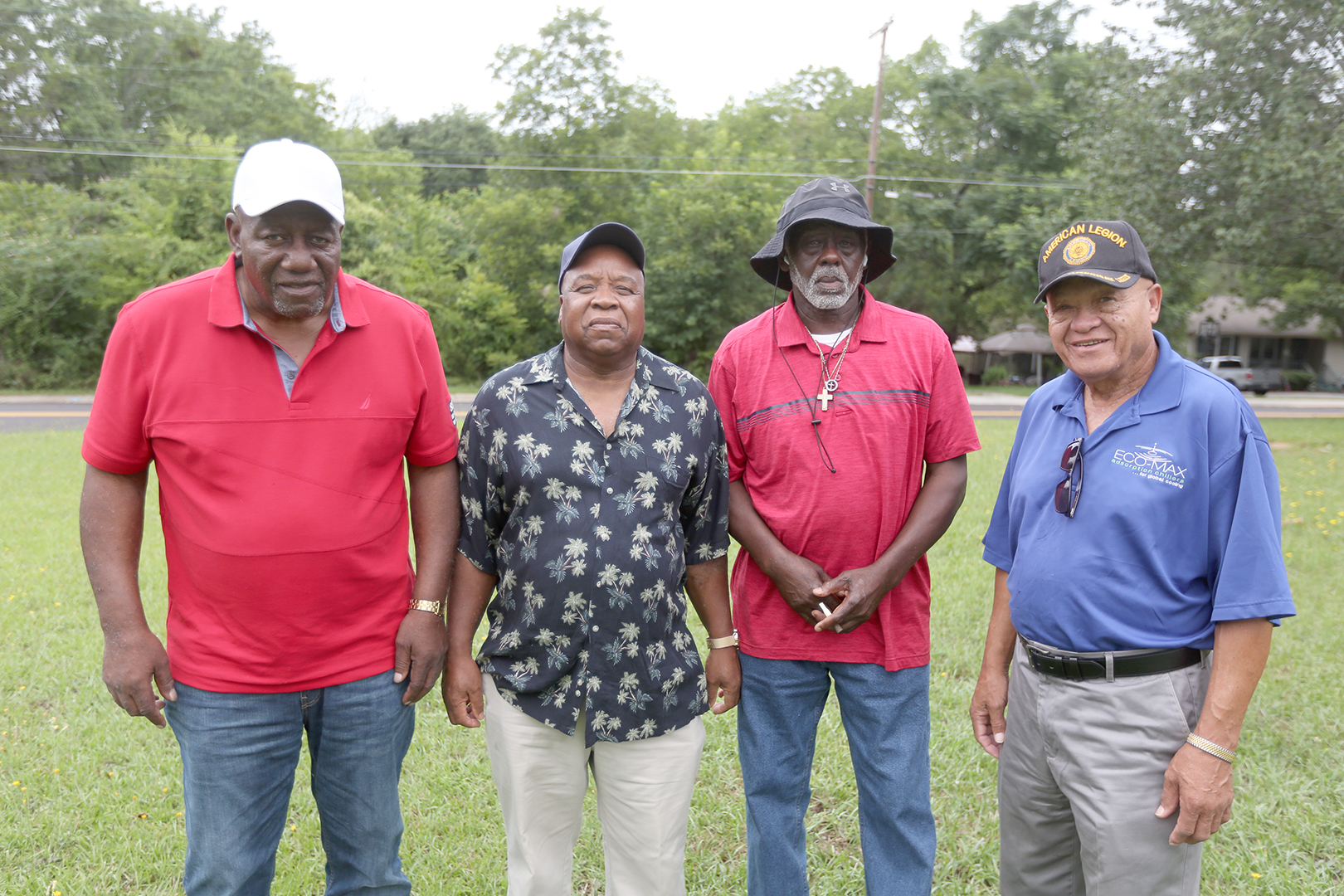
Former St. Paul Braves teammates (L-R) Murray Morrison, Eddie Sanders, Epp Thompson and Terry Burton reunited at the Blackwell Memorial Cultural Center Saturday, July 9. (Photo by Scoggins)