
BOE seeks to engage the public in decisions about aging buildings
By Julie Weeks
jweeks@elberton.com
In an effort to inform the public and start a dialogue about the future of the county's aging school facilities, Elbert County School Superintendent Robert Wheeler hosted a presentation last Thursday at Elbert County Comprehensive High School (ECCHS) outlining long-range needs regarding the county's current school buildings.
Wheeler emphasized the board is in a research and brainstorming stage, and that no decisions will be made without further study and input from the community.
According to Wheeler, his goal is to devise a long-range plan to avoid a "log jam" of repairs to or replacements of current facilities, which— if not spaced out—would leave the county with huge repair/remodel expenses coming all within 10 years of each other.
Based on structural issues documented at ECCHS, Wheeler shared that the facility, completed in 1976, is past the state's recommended 40-year mark, as it turns 50 next year. According to Wheeler, current issues at the high school which need addressing include the boilers, HVAC systems, electrical switch gear, and sanitation water lines. Wheeler also pointed out issues with the current structure regarding safety—an issue that was not a key focus for school architects in the 1970s. Of concern are the "number of entrances, twists, turns and levels, windows and lack of a security vestibule," he said.
"The state expects schools to last 40 years and expects major renovations, modernization or new construction to happen by year 50," Wheeler said.
"The state capital outlay program assists with capital projects with the big modifications such as roof, HVAC, canopy and kitchen equipment.
Once a renovation or new construction project is completed, 10 years must pass before the district can apply entitlement funds towards that building," he said.
Wheeler said the board has studied the energy efficiency of all of the current buildings as well, and compared to the newest updates to Elbert County Primary School (ECPS)—whose energy costs average five cents per square foot—ECCHS averages 19 cents per square foot. This currently translates to $250,000 per year which could be saved if the facility were more energy efficient, he said.
The current high school facility is also not in compliance with the Americans with Disabilities Act.
Wheeler shared the repair or replacement timeframes for the remaining facilities: ECCHS by 2029; Elbert County Elementary School (ECES) by 2049; Elbert County Middle School (ECMS) by 2059 and ECPS by 2074.
The most immediate concern, according to Wheeler, is the high school. He listed four options for dealing with the aging facility: 1) take no proactive measures and fix systems as they fail; 2) target repairs and replace or update needs and concerns that are feasible; 3) complete a modernization plan which would involve gutting the building, and replacing systems and finishes but does not address the safety issues; or 4) build a new high school.
Wheeler addressed pros and cons of each action, noting issues with disruption to school day, impacts to traffic, absence of safety solutions and projected costs for each option.
According to Wheeler, the board obtained rough estimates for all the options which he outlined as follows:
Targeted repairs would cost approximately $23 million with approximately $11 million needed in bonds after applying capital outlay funding and SPLOST/assigned funds. Modernization would cost approximately $50,000 and would require approximately $34 million in bond funds with similar funding applied. New construction would cost approximately $68 million with $39 million needed in bond funds. Wheeler summed up the plan options saying, "Targeted repairs are a short-term response that is the worst long term plan for functionality as well as financially. Modernization will provide functional systems but does not address the layout. For an additional $6 million, we could build exactly what we want. New construction fits within the 50 year plan. It's possible within the upcoming window. It's the best long-term option," he said.
As for financing the projects, a new facility would maximize state-provided capital outlay funds as well as provide $3 million for a career academy, giving the county approximately $17 million towards the new construction project. Projected SPLOST funds would contribute another $12 million, leaving the bond amount at approximately $39 million. The modernization project would net only $4.5 million in capital outlay funding. Wheeler said the projected numbers for the SPLOST used in his discussion assumed annual growth of 1-3%; however, the actual growth for the past few years has been 8%, which, if holds true in coming years, would give even additional cushion for other expenditures aside from the repairs/remodel/construction expenses associated with the high school project.
Wheeler said the next steps in the process are to gather input from the county and continue to research the options. He said similar meetings will be held in the future and an email survey will be going out to stakeholders within the next few weeks. " We'll have a link to our district webpage for the information on social media and mass messaging system. The information and survey will be accessible on the web page," he said.
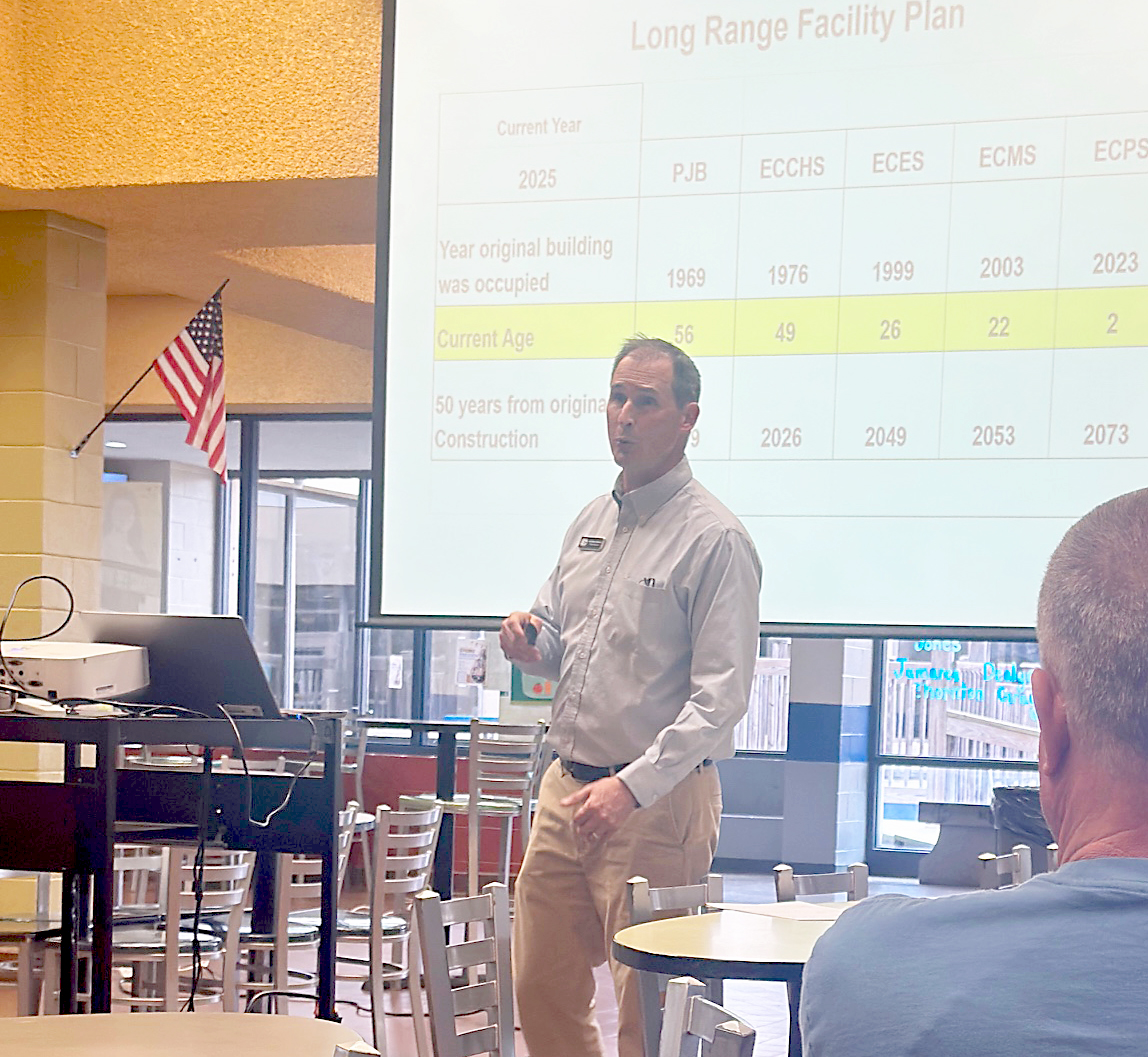
Elbert County School Superintendent Robert Wheeler discusses options for aging facilities at the March 20 meeting at ECCHS. Approximately 50 citizens attended the meeting. (Photo by Weeks)