
While the Korean War saw the height of its conflict while John N. “Pete” Anderson was in high school, he received a notice in the mail that he had been drafted into the United States Army when he was 23 years old.
Anderson, who had been working at Walter Gaines’ Motor Company since he was 16, said the draft came after Gaines, who was friends with someone on the draft board, helped him get six, six month deferrals due to the need for mechanics.
The time for deferring his draft came to an end, and on July 8, 1958, Anderson was officially sworn into the Army for a two-year commitment.
As he prepared to go to basic training, Anderson said he received a medical exam twice as a case of rheumatic fever when he was 11 made him deaf in one ear at the age of 16.
After the second exam, Anderson went to Fort Jackson in Columbia, South Carolina for basic training where he said he was told by one of the doctors that he would be given a "profile" due to being deaf.
“He asked me ‘How you like the service?’ I said ‘I don’t like it.’ He said ‘Well, you’re deaf in one ear, you can stay two years, but I’ll give you a profile – be around no noise except what it takes to complete basic training. That profile is still on my records over here in Athens right now," Anderson said. "They put me in the noisest outfit the Army had for 13 months when I went to Korea."
During his third of week of basic training, Anderson said he and a fellow serviceman, William S. Gailey, were told to report to the day room where they were greeted with “two tables full of tests.” They were told they had the two highest scores on a previous mechanical test and were told to take the ones in front of them.
“We took that test. They told us we were going to post motorpool there in Columbia – Fort Jackson, as soon as we finished basic training,” Anderson said. “That’s the biggest lie somebody ever told.”
After he made a 98 on the test and Gailey made a 96, they were told to report for eight weeks of mechanical school.
“I told Gailey ‘Well, they must be trying to familiarize us with all these army vehicles before we go to work on them,’” Anderson said.
Eight weeks later, the pair graduated at 11 a.m. one morning and were told to report to the dispensary.
“We got up there and they said ‘Pull your shirts off and find you a chair to sit down in.’ We said ‘What’s going on here?’ Old boy said ‘You’re fixing to take a cholera shot.’ Buddy, that thing will knock you down, you better sit down. It feels like it cuts your arm off for about two minutes, then it’s gone,” Anderson remembered. “I said ‘What is this for?’ He said ‘You’re going to the far east somewhere.’”
Anderson said he and Gailey were the only two out of 107 men in their basic training unit to receive the orders that would take them from Columbia to Washington in less than 24 hours.
Anderson was told to call his wife, Valgene, who he married in 1956, and his parents, Harry and Louise Anderson, made the trip to Columbia to allow the couple to say goodbye before he left Fort Jackson.
At 5 a.m. the next morning, the pair flew out of Fort Jackson and flew to Augusta, where Anderson said they “picked up boys from Fort Gordon,” before flying to Atlanta.
The group then flew from Atlanta to Chicago and then from Chicago to Seattle, Washington, where they arrived around 11 p.m.
During a three to three-and-a-half week stay in Seattle, Anderson said he was tasked with keeping the furnaces fired up as Seattle was receiving snow and freezing temperatures.
On a cold and rainy day nearly a month later, they boarded a battleship at Pier 51 to make the ride over to Yokahama, Japan.
After an overnight stay in Japan, the crew boarded the boat again and set off for Korea. The day after Christmas, they reached their destination. Rather than pulling directly to shore, Anderson recalled having to de-board the ship by walking on a gangplank nearly three quarters of a mile long.
“That was a sight to see. That boat pulled up and it was like you see a gangplank, at least as far as from here to the post office,” Anderson said while sitting in The Elberton Star office. “And with that big ole duffle bag, that ole flimsy wooden gang plank just swinging out there, and you have to walk that thing, at least that far, or maybe to Hicks Funeral Home. [You were] scared and it was raining and sleeting and snowing.”
Anderson said he made it off the gangplank, where he then climbed a “straight up” dirt bank before getting to the buses there to take them to the next destination.
During his 13 months in Korea, Anderson said the weather was similar to Georgia’s weather except during the times of the “Northeasters” and the monsoon season.
“I walked guard [in] 17 below [temperatures],” Anderson said. “2 a.m. to 4 a.m. was my shift. Light snow, you couldn’t make a snowball. Wind blowing 40 miles an hour and that lasted about a week.”
During the monsoon season, that he said would begin in August and last for 30 days, the mud would be so bad that he would have to change boots sometimes three times a day.
Anderson spent his time in Korea as a mechanic in the 30th Ordnance heavy maintenance unit, where he said they “rebuilt tanks and artillery.” The unit was comprised of 108 men and 80 mechanics.
Specifically, Anderson said he worked in the motorpool, keeping the company’s vehicles running.
Anderson said “the most thrilling” event that happened to him while in Korea was the time he was involved in transporting one of the “Honest John” missiles.
One day, Anderson was asked to report to the commander, who introduced him to John Simpson of the Aberdeen Proving Ground in Maryland.
“That’s the biggest thing the military’s got on checking stuff out,” Anderson said during his recount of the day. “All they do is keep everything running, mostly vehicles, armor and machine guns, stuff like that.”
Simpson told Anderson to go out and recruit four drivers from the company.
“I got the four drivers,” Anderson said. “[Then] he said ‘We are bringing the Honest John missile to Korea.’”
The group then made two trips to Ascom City, a military post about 20 miles away, to get the missiles and the accompanying materials.
“[There was] one big five-ton wrecker with a launchpad on it, three five-ton trucks with three big ole missiles on each truck,” Anderson said. “Each truck had a trailer behind them with a big ole electric unit that shot that thing off. Electricity fired them. We got all that stuff up there with two or three trailers with wenches on them and a block tackle to pick that missile up off the ground and set it up there on that launch pad. We got all that stuff up there and got it all working.”
Later, after they’d gotten everything completed, Anderson was told they were going to leave the location they were in and move the missiles about 40 to 50 miles closer to the coast.
“I had done been up there once or twice, me and the motor sergeant went up there. We were burying tank carcases with brand new 90 and 105 guns pointing them down on the [demilitarized zone] (DMZ),” Anderson said. “With a pair of binoculars, you could see them on the other side, digging in and burying ammo over there, the Koreans getting ready.”
Part of the journey included crossing a bridge, which Anderson said was strapped with cans of black powder that could be easily blown up if needed by the press of a button.
When they got to where they were going, Anderson said they were approached by a first lieutenant who asked if they could “try” one of the missiles out. As the missiles were no longer loaded with powder or warheads and had had their use, Simpson told the sergeant yes.
“Mr. Simpson said ‘It belongs to y’all now, I’m through with it, y’all can do what you want to.’ He said ‘Well I’m going to shoot it about three miles down range. I just come from Los Alamos, New Mexico where the missile place is out there,’” Anderson recalled. “They loaded that thing...it just had enough fuel to carry it a little bit of feet. That sucker went out yonder and it made the prettiest turn and it went right over there in North Korea and lit. I told Mr. Simpson, I said ‘Buddy that bridge down yonder we crossed – dynamite it. Let’s get out of here. He said ‘Yeah, let’s go.’ So we took off.”
Anderson said Simpson later offered him a job as his replacement at Aberdeen, but Anderson declined as he already had plans to return home to Elberton and go into business.
While in Korea, Anderson said there were several times where his company was “on alert,” and although he was a mechanic, he “played soldier.”
“We played soldier. We had so many alerts, it was pitiful. We had to get in the foxhole. Everywhere we went, we carried loaded guns,” Anderson said. “You carried it to the chow, you laid it down beside the table. You carried it to the bed, you laid it down beside the bed. You were a soldier because those North Koreans were coming across the DMZ and they said they were trying to kill the South Korean president. We went completely on the alert. We had a little box that had a little round thing in it and if we had to evacuate and leave some vehicles, we had to take the spark plug out and drop that pill down in that spark plug and screw it back in there. If anybody ever turned that engine over, it blowed it off.”
After his 13 months were up overseas, Anderson returned to the states in January 1960 where he was stationed in Fort Campbell, Kentucky. While there, he was assigned to the 21st Ordnance, the 101st airborne division.
“[I] kept them up, kept their vehicles going,” Anderson said. “I was the oldest mechanic they had.”
After three months of being in Kentucky, Anderson was given the gift of returning home in April, a few months before his estimated time of service in July.
“I got out early and come home. I knew I’d have to make two years in either the Hartwell reserves or the National Guard, so I went down and talked to the National Guard. They said ‘We’re going to camp.’ I said I didn’t want to go to no camp as hot as it [was],” Anderson said. “He said ‘Wait, Tommy Harper’s going to get out.’ He said ‘He’s the motor sergeant...why don’t you take his job.’ I made them two years and I got out. I said ‘Boy I got it made, I don’t have to drill no more.’”
Less than two weeks after his two years with the National Guard ended, Anderson received another letter in the mail from the war department.
“You[‘re] enlisted back in the army for two more years,” Anderson said of the purpose of the letter.
Just before he was set to go to Fort McPherson in Atlanta, he received another letter that told him to report to the Hartwell reserves for another two years on active standby.
“You[‘re] there, you got no job. You get this detail and that detail, hoping that they don’t call you. That’s what I did for two more years,” Anderson said. “I finally got out in 1964.”
After he left the reserves, he returned to work at the Pontiac car dealership. He then went to the Chevrolet dealership before deciding to sell insurance for a time. He then bought into the service station business in 1963 with the James Brown Service Station. In 1975, he went to work with Chevron, where he retired from in 2010 at the age of 75.
Pete and his wife, Valgene, continue to live in Elberton, just a short ways down the road from where he was born near Sweet City. The couple has three children – Gary, Rhonda and Carla.
While he remembered not liking being in the military during the time of his service, looking back, Anderson said he’s glad he served.
“While I was in there, I hated it because I had something else to do and I wasn’t no military man. But I tried to do the best job I could while I was in there,” Anderson said. “Right now, I’m kinda glad that I did serve. I’d like to go back to Korea one more time to see what that place looks like. It was burnt. There wasn’t a tree over there over 10 foot tall. They wiped that sucker clean in the war. We always had a saying, ‘There’s the right way and the Army way.’ The Army way ain’t always right. You have to do things you don’t want to do.”
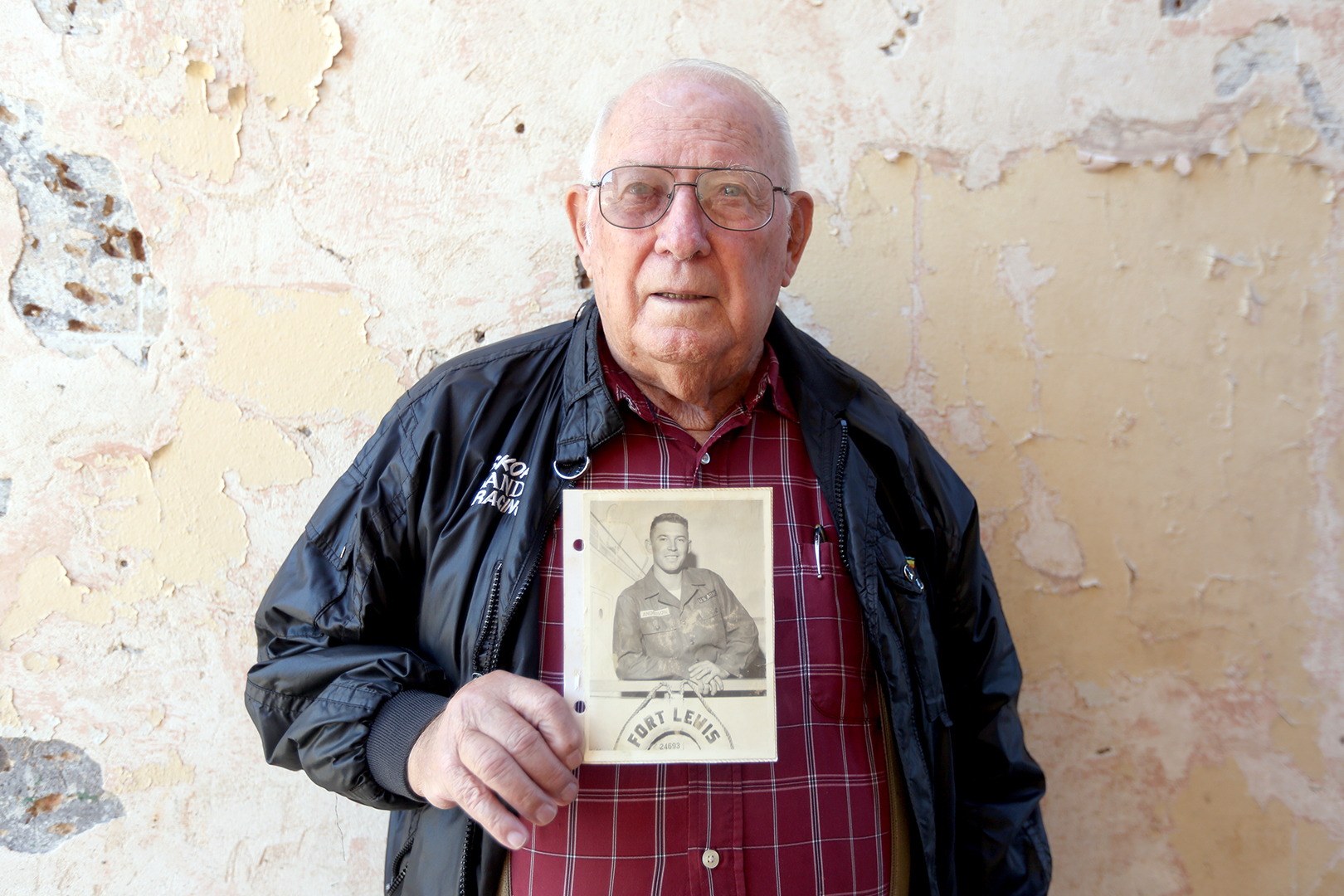
Elberton’s John N. “Pete” Anderson, 88, holds a photo of him taken aboard a ship at Fort Lewis, now Joint Base Lewis-McChord in Tacoma, Washington before being shipped off to Korea in 1958. (Photo by Scoggins)