
11-year colon cancer survivor raises support, awareness
Although March and Colon Cancer Awareness Month are winding down, 11-year survivor and founder of the Elbert County Colon Cancer Support Group (ECCCSG) Pam Allen is continuing efforts to raise awareness and encourage screening throughout the entire year.
“I want to be able to help somebody. That’s my reason for doing this – so I can be able to help somebody, so I can be able to save a life and be able to help prevent someone from going through this disease,” Allen said March 24. “I tell people all the time, colon cancer is one of the cancers that you don’t have to get. It’s preventable. It comes with screening – that’s why it’s so important.”
Allen was diagnosed with Stage III colon cancer in 2012 after undergoing a routine colonoscopy through a “Welcome to Medicare” physical. As someone who prided herself on keeping in shape, Allen never thought she’d hear the word cancer – and had never even heard of colon cancer.
“[The doctor] said we found cancer and I said ‘Oh, what cancer?,’” Allen recalled. “It never dawned on me. Ignorant me, it still did not register on my because I did not know. I was ignorant to the fact of what it was.”
In order to educate herself, Allen said she turned to researching on Google – something she warns those who receive a diagnosis not to do.
“When I got through reading Google, I was planning my funeral. Every time I came down my driveway, I was saying ‘How many more times am I going to be able to look at my flowers?,’” Allen said. “Looking at Google, within less than five years, I would be dead. That’s why I tell people ‘Do not let Google be your friend. Google will make you die in your mind.’”
Looking back to the time leading up to her colonoscopy, Allen said she had symptoms, but didn’t know that they were, in fact, symptoms of colon cancer.
“That’s one reason too why I do this, so people know the symptoms and the signs of colon cancer. There were signs. Because the signs and symptoms of colon cancer are so common for everything else, it doesn’t equate this in your mind. You don’t think cancer,” Allen said. “When you’re just constipated, you don’t automatically think you need to go to the doctor. When you’re gassy, when you’re bloated. I tell people also, the No. 1 symptom is there are no symptoms. That’s why screening is so important.”
According to the Fight Colorectal Cancer organization, symptoms include “a change in bowel habits; blood in the stool; diarrhea, constipation or feeling that the bowel does not empty completely; stools that are narrower than usual; frequent gas pains, bloating, fullness or cramps; weight loss for no known reason; and feeling very tired and weak.”
Risk factors, according to the organization, include age, a family medical history of polyps, colorectral cancer or inflammatory intestinal conditions and a variety of lifestyle conditions include “a high diet in red meats, processed meats and fat, low physical activity, obesity, smoking and heavy alcohol use.”
Following her diagnosis, Allen had a colon resection and took chemotherapy treatments. In 2013, she took her last treatment and has been cancer-free for going on 11 years.
Allen credited her faith in helping her through her diagnosis and treatments.
“God’s word came back to my mind. It just said ‘You should live and not die.’ That just kept replaying in my mind,” Allen said. “That’s what got me through. I’ve had some good experiences and some bad experiences, but through it all God has kept me and I’m still here today.”
Before she completed chemo, Allen said “God laid it on her heart” to do a “Blue Day” to show support for those going through the same situation. After approaching her pastor, Allen jumpstarted the event in her church.
As time passed, the event grew and has been consistently recognized throughout the City of Elberton with an annual proclamation recognizing a “Dress in Blue Day” each March.
Just a few years later, Allen founded the ECCCSG and began fund-raising in order to help alleviate some of the financial hardships she said cancer patients, and their caretakers, endure.
The group holds an annual banquet – which took place March 19 at the Elberton Arts Center – and participates in the Belk Charity event in April. The group also held its first annual walk in 2022 and Allen said she plans on hosting another walk later this year.
The annual banquet includes speakers and doctors from the University Cancer and Blood Center in Athens that Allen said speak on different aspects of colon cancer.
While Allen said sometimes people are “embarrassed” to talk about certain aspects of colon cancer, they are necessary in order to help people keep an eye out for symptoms.
“I know this is something no one wants to talk about, but I have got to say it,” Allen said she told the group during the March 19 banquet. “I said ‘Y’all have got to start looking at your poop. Don’t just wipe and flush, you’ve got to look at it. The color, shape, size – it tells a story about your body. The shape of your poop tells you something. People oftentimes are embarrassed to talk about that, but we all have a rectum. We all have a colon. We all poop. That’s nothing to be embarrassed about. We all do it, it’s a part of life.’ It was fun but informative.”
One of this year’s speakers spoke on survivorship and the last side effects – both physical and emotional – that those diagnosed live with.
“One of the things we don’t think about as a side effect but is, is the emotional stress,” Allen said. “Once you’re diagnosed with a late stage of cancer, you’re emotionally never stable because you’re always wondering ‘Is it going to come back?’ Every time I go to the doctor for a scan, I’m always nervous about what the results are going to be. You just never know. Still, I don’t care how far you’re out as a survivor, you still need that emotional support. You always need that.”
The group is also there to provide support and is made up of other survivors and caretakers who know what those diagnosed go through.
“You have a support group, you have someone you can talk to who understands,”Allen said. “We do want people to reach out to us and we want people to know we are here to help as well. I just want you to know we’re here to help you.”
Allen said she also attends events throughout being an official ambassador with the Fight Colorectal Cancer organization. March 11 through March 16, Allen traveled to Washington, D.C. to participate in a 17th Annual “Call-on Congress” event.
The group spoke with members of Congress, asking them to create a colorectal cancer research program with the Department of Defense’s Congressionally Directed Medical Research Program and asked for funding to be allocated to the Centers for Disease Control’s Colorectal Cancer Control Program.
Allen said the measures would not only help increase awareness and research for everyone, but especially for those in African American communities who she said are not being screened or educated.
While some have barriers in access to screening, Allen said others who may have access delay screening because they don’t want to do the “prep” for a colonoscopy.
“I tell people the colonoscopy is not the worst part. It’s easy, breezy,” Allen said. “That’s why I’m so thankful they’ve got all these different types of preps now that people can do. Whatever makes it easy for people to be able to get screened. I don’t complain about the prep, because I know it’s lifesaving. I’d rather do a colonoscopy than chemo.”
While in D.C., Allen also participated in laying 27,400 blue flags on the National Lawn to represent the number of people under the age of 50 who are estimated to be diagnosed with colorectal cancer in 2030. A study from the Journal of the American Medical Association estimates that colorectal cancer “will be the leading cause of cancer death for those ages 20 to 49” in 2030, according to the Fight Colorectal Cancer website.
According to the American Cancer Society, the recommended age for regular colonoscopy screenings is now 45 years old, down from a prior age of 50. Allen said while she’s thankful the age has been lowered, she hopes to see it continue to decrease.
“We used to think it was an old person’s diseases. It’s no longer an old person’s disease because you’ve got so many young people who’s dying from colon cancer. We’ve got to change. The thing that bothers me is that nobody can tell you why these young people are dying.”
As Allen continues her outreach efforts on educating the community about colon cancer, Allen encourages everyone to be screened, to change the stigma around talking about the disease, to look out for the symptoms and to learn their family history.
“You hear people talk about breast cancer and you even hear men talk about prostate cancer, but you don’t hear too many people talk about colon cancer,” Allen said. “We just try to change that stigma. We don’t want people to feel embarrassed to talk about colon cancer. It’s out there. It’s real. It’s a killer. But the thing about it is, it doesn’t have to kill anybody. Colon cancer is beatable, treatable and preventable. No one has to die from colon cancer. That’s why screening is so important. I can’t stress that enough.”
For those interested in receiving information – including brochures around screening and symptoms, or for those who have been diagnosed – the ECCCSG can be reached by calling 706-207-6575, 706-498-0906 or 706-988-0371 or by emailing ecccsg001@gmail.com.
“It does my heart good to know if we only help just one person. If one person just comes back and said ‘Mrs. Pam, I heard you say this and I went and got a colonoscopy because I heard you say it saved your life.’ I’ve actually had people come and say that,” Allen said. “Every time I see somebody, they say ‘Yes Mrs. Pam, I’ve had my colonoscopy.’ They know that’s what I’m going to ask. It’s worth it. If I can help one person, it’s worth continuing to do.”
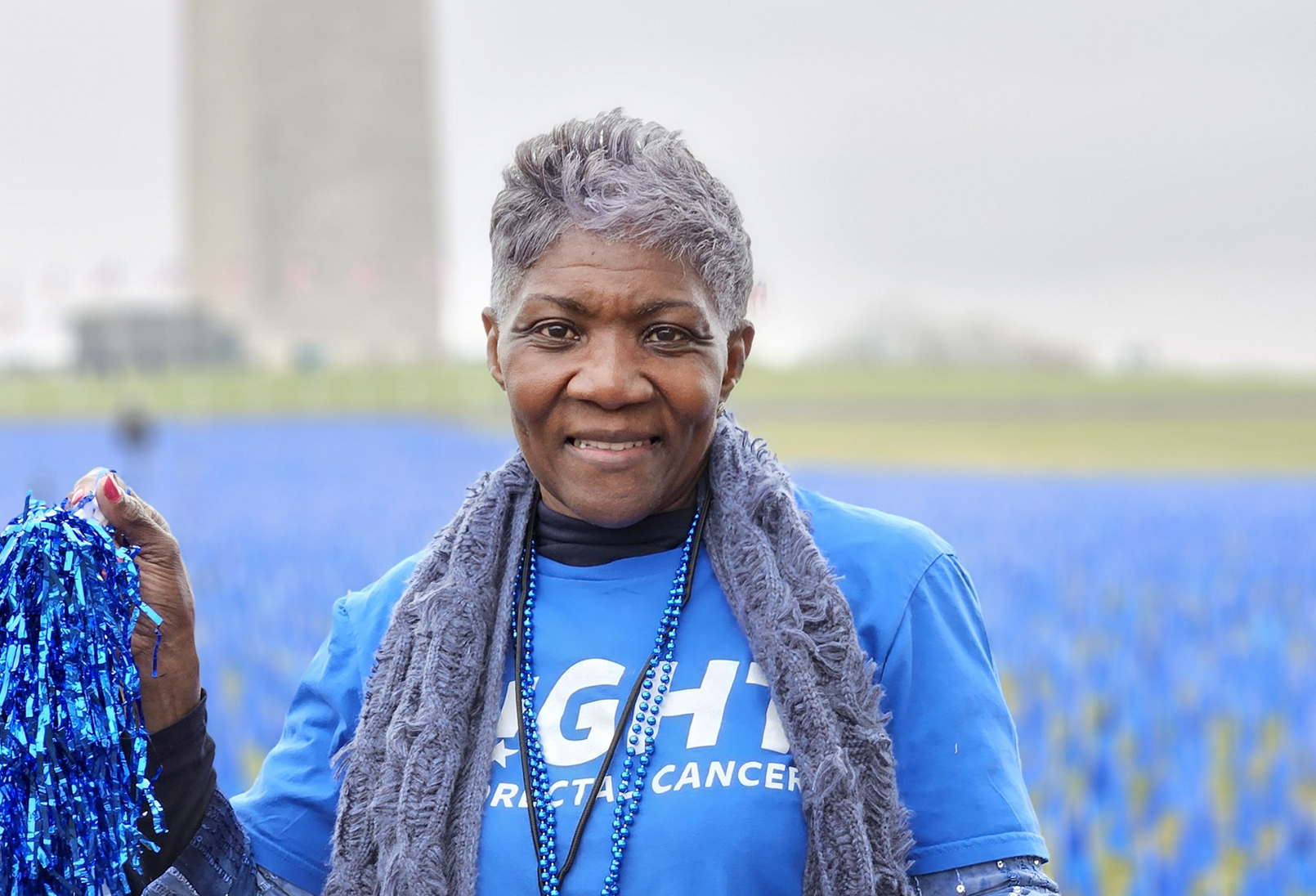
Colon cancer survivor and founder of the Elbert County Colon Cancer Support Group Pam Allen traveled to Washington, D. C. earlier this month to advocated for colorectal cancer research as part of Colon Cancer Awareness month.